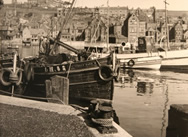
Cooks' skills, dedication and intellectual reputation eventually brought him to the notice of the Royal Society, however It was the Admiralty which appointed Cook to Endeavour on the strength of his charts of Newfoundland, on the recommendations of Captain Palliser and perhaps on Cook's report of an eclipse seen from Newfoundland. The Royal Society might have noted the report of the eclipse, but Cook was the Admiralty's choice which led to his appointment to lead HM Bark Endeavour in her epic voyage to the Pacific. Her mission was to carry Admiralty and members of the Royal Society to observe the transit of Venus from Tahiti and to explore the possibility of the existence of a Great Southern Continent. As a Whitby-built collier, solid and flat-bottomed and thus easy to beach and repair, the Endeavour was familiar to Cook and he took command, as lieutenant, on what was to carve the way for a two further monumental voyages. Each voyage not only furthered Cook's impressive career but were also pivotal in furthering scientific understanding and exploration.
The first voyage (during which Cook circumnavigated and charted New Zealand) with
HMS Endeavour and second and third on board HMS Resolution
HMS Resolution saw Cook become the first man to circumnavigate the globe in both directions, from east to west then west to east respectively, and the publication of his personal journals gained him higher reputation still within the scientific community. His first voyage established the charting of the east coast of Australia and the entire coast of New Zealand, and the second, dispelling the notion of a Great Southern Continent, sailed south to Antarctica, achieving the first Antarctic Circle crossing in 1773.
The third of Cook's voyages, this time on-board
HMS Resolution, in search of the North West Passage through the Bering Straits, ultimately ended in Cook's demise during a fight with the local inhabitants on the island of Hawaii in 1779.